
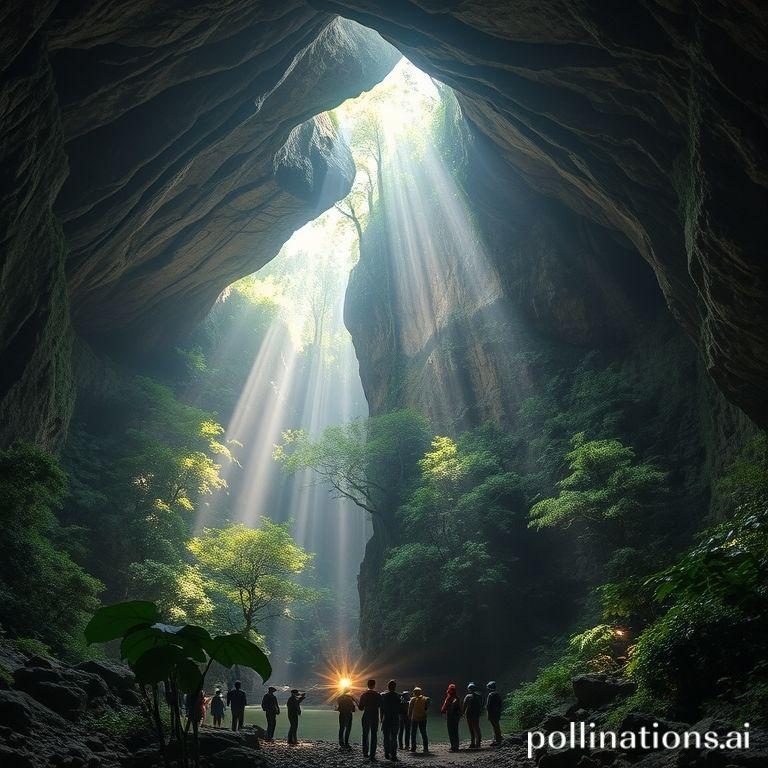
Imagine walking into the biggest underground world on Earth, hidden deep in Vietnam’s green mountains. This is the Phong Nha Cave system, a UNESCO World Heritage site that’s like nature’s grandest cathedral. Think of it as an underground city with over 300 different rooms and hallways stretching across 126 kilometers. The biggest cave, called Son Doong, is so massive it could swallow an entire New York City block with skyscrapers and still have space left over.
What makes this place truly special isn’t just the rock formations—it’s the secret world of life that has grown here. Like finding treasure in a hidden chest, scientists have discovered blind fish, see-through spiders, and rare plants that live only in this permanent darkness. Above ground, the landscape is just as amazing, with emerald rivers cutting through limestone mountains covered in ancient forests.
Nature’s Underground Workshop
Picture this: over 400 million years ago, this whole area was an ancient ocean. The limestone that forms these caves started as coral reefs and sea sediments, like layers of a giant underwater cake. When the earth pushed this seabed up into mountains, rainwater—acting like a gentle acid—began slowly dissolving the rock. It’s like watching an artist carve a masterpiece, drop by drop, over millions of years.
The rock here is incredibly thick—up to 1,000 meters in some places—giving nature plenty of material to work with. With heavy rainfall constantly supplying fresh “carving water,” the caves keep growing and changing. Rivers have cut through the limestone like nature’s sculpting tools, creating both surface valleys and underground waterways.
Dr. Howard Limbert, a cave expert, says: “The Phong Nha-Ke Bang karst is probably the finest and most distinctive example of its type in the world.”
Explorers are still finding new passages every year, like discovering new rooms in a mansion you thought you knew well. In 2022, they found tower-like formations reaching over 80 feet tall—nature’s skyscrapers built over thousands of years.
The King of All Caves: Son Doong
Son Doong Cave is the superstar of this underground world. Think of it as the grand central station of caves—so huge that a Boeing 747 could fly through its main chamber. The cave stretches 9 kilometers long, with some sections reaching 200 meters high and 150 meters wide.
Getting inside requires climbing down an 80-meter cliff face—like rappelling down a giant’s staircase. Once inside, you’ll find the cave has its own weather system, with clouds forming in the larger chambers. Where the roof has collapsed, sunlight streams in to create magical underground jungles where monkeys and rare birds live.
One of the most famous spots is the Great Wall of Vietnam—a 90-meter high barrier that adventurers must climb. Beyond it lies the final chamber with spectacular formations, including the Hand of Dog stalagmite, standing tall like a natural monument.
Guide Nguyen Chau A explains: “Son Doong isn’t just a cave—it’s a wilderness experience that tests your limits while rewarding you with sights few humans will ever witness.”
Only 1,000 visitors are allowed each year to protect this fragile environment, making it like an exclusive club for serious adventurers.
The River Cave: Nature’s Water Palace
Phong Nha Cave offers a gentler introduction to this underground world. Imagine floating on a boat through a mountain, following a river that flows right through the rock for nearly 8 kilometers. The cave gets its name from the Vietnamese words for “teeth wind,” describing the tooth-like formations at the entrance.
As your boat glides into the darkness, the temperature drops and the outside world disappears. The first kilometer is electrically lit, revealing formations that look like lions, fairy caves, and royal courts. It’s like entering nature’s art gallery, with each formation telling its own story.
Humans have been visiting this cave for thousands of years, leaving behind ancient writings and evidence of early habitation. It’s like walking through a living history book written in stone.
Paradise Cave: Heaven Underground
Thien Duong Cave, or Paradise Cave, truly lives up to its heavenly name. Discovered in 2005, it stretches for 31 kilometers, though only the first kilometer is developed for visitors. Getting there requires climbing 524 steps—like ascending to nature’s cathedral.
Inside, you’ll find formations that look like:
- Cactus Garden: Stalagmites resembling desert plants
- Fairy Terrace: Delicate formations dancing in the light
- Bamboo Forest: Stone columns creating a petrified grove
Some stalagmites reach heights equivalent to 15-story buildings, having grown at the slow pace of one centimeter every 1,000 years. For the truly adventurous, there’s a 7-kilometer wilderness tour that takes you beyond the developed areas.
Guide Tran Thi Lan shares: “The developed section of Paradise Cave shows you the beauty, but the wilderness tour shows you the soul of the cave.”
Dark Cave: Nature’s Mud Playground
Hang Toi, or Dark Cave, offers a completely different experience. True to its name, the cave is completely unlit, requiring headlamps to navigate. The adventure begins with a zipline over turquoise waters, delivering you to the cave entrance.
Inside, you’ll find a unique mud chamber where thick, mineral-rich mud makes you buoyant—like floating in nature’s pudding. Beyond the mud, narrow passages lead to a sandy beach inside the mountain where an underground river emerges.
Protecting Nature’s Masterpiece
As more people discover these amazing caves, protecting them becomes crucial. Think of it like preserving a priceless painting—we want everyone to see it, but we must be careful not to damage it. Conservation measures include:
- Strict limits on visitor numbers for sensitive caves
- Raised walkways to protect delicate floors
- Careful lighting to minimize impact on cave life
- Leave No Trace principles for all visitors
Local communities have become important partners in conservation. Many former hunters now work as guides or park rangers, creating economic benefits from protecting rather than exploiting the environment.
Park director Nguyen Van Ky emphasizes: “Our goal is to create a model where conservation and sustainable development support each other.”
Planning Your Underground Adventure
Visiting these caves requires some planning, like preparing for a journey to another world. Here’s what you need to know:
Best Time to Visit: February to August offers the best conditions, with lower rainfall and stable river levels. Think of it as nature’s open season for exploration.
Getting There: Phong Nha is about 500 kilometers south of Hanoi. The most convenient access is through Dong Hoi City, which has both an airport and railway station.
Tour Selection: Choose based on your interests and fitness level. First-time visitors often combine Phong Nha Cave and Paradise Cave. Adventure seekers might try Dark Cave or multi-day expeditions.
Remember that cave exploration in Phong Nha is about more than just seeing amazing sights—it’s about connecting with ancient geological processes and becoming part of the ongoing story of human discovery. These caves remind us of nature’s incredible power to create wonders and our responsibility to protect them for future generations.