
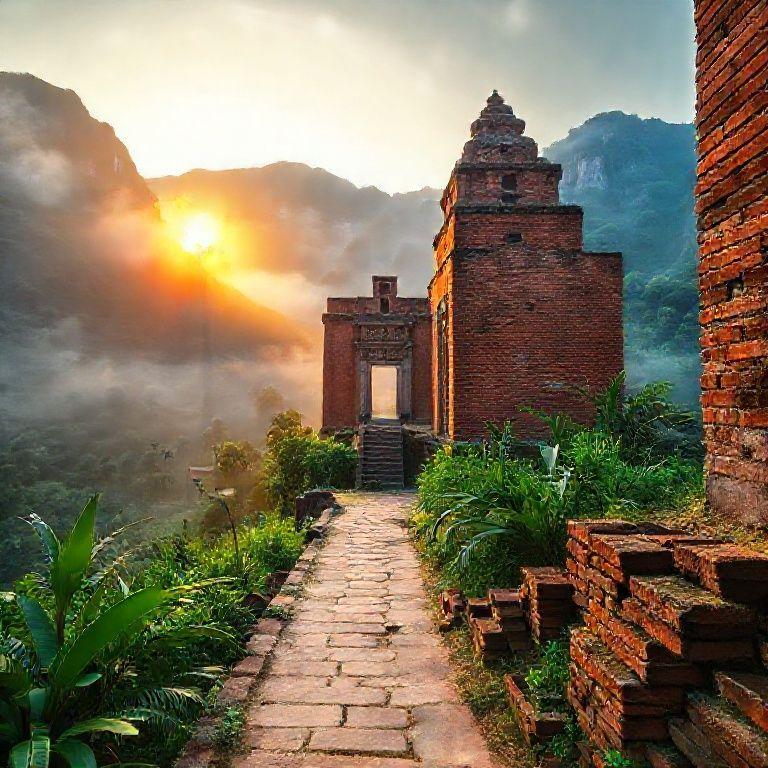
Imagine a place hidden in a green valley, cradled by mountains that stand guard like sharp teeth. This place is called My Son Sanctuary. It is not just old broken buildings. It is the spiritual center, the very soul, of an ancient kingdom called Champa. Its story has echoed for more than a thousand years.
It is a short trip from the busy, colorful town of Hoi An. The two places are like different chapters in the same history book. Hoi An is a living story of markets and lanterns. My Son is a quiet whisper about gods, kings, and amazing builders. Going to My Son is not just a visit. It is like a journey into the deep heart of Vietnam’s past.
This guide will walk with you. We will explore the history of the Champa Kingdom. We will learn about the hidden meanings in the stone carvings. We will give you practical tips for your trip, like when to go and what to wear. We will also talk about the site’s sad modern history and how people are fixing it. Finally, we will connect these ancient stones to the living culture of Vietnam today. To see this majestic place come alive, visit our YouTube channel, @JourneyVietnam.
The Champa Kingdom: A Powerful Realm
The story of My Son is tied to the Champa Kingdom. This was a sea-faring power that lived along the coast of Vietnam from about the 4th to the 13th centuries. It was different from its northern neighbors. Champa was heavily influenced by ideas from India. They followed Hinduism and used Sanskrit for holy writings. The kingdom was like a network of smaller states. My Son was its most important religious center. A king started building it in the late 4th century to worship the god Shiva. For over nine hundred years, kings kept adding to it. Each new set of temples was like a personal prayer and a show of royal power.
Architectural Genius: Speaking Through Brick and Stone
The temples of My Son are incredible works of brick art. The Cham people were masters of building with brick. They fit the bricks together so tightly that you can’t slide a razor blade between them. They might have used a special paste that has worn away over time.
The buildings themselves are a map of Hindu beliefs. Each main tower is like a model of a holy mountain, which was thought to be the center of the universe. The site has many groups of buildings. Each group has a main tower that held a sacred statue. The detailed carvings on the stone show stories from holy books, heavenly dancers, and mythical creatures. As one expert said:
The art of My Son is a conversation between the local spirit of Champa and the borrowed ideas of Indian art, making something totally new.
Walking Through the Valley: A Tour of the Temple Groups
Today, you can walk through a protected part of the valley. You start at a visitor center with a good museum. A bus takes you to the main area. A walking path loops around the most important temple groups.
- Groups B and C are some of the oldest. They have towers with carvings that are still clear.
- The great A1 tower is now a powerful ruin. Its broken shape reminds us of the site’s difficult history.
- Group G shows a later style of building.
As you walk, go slowly and look closely. Notice the worn steps, the carvings covered in moss, and the way light shines through broken roofs.
Planning Your Visit: Helpful Tips
To enjoy your trip, a little planning helps. My Son is about 40km from Hoi An. You can join a tour or hire a private car. The site opens very early. Getting there at sunrise is the best plan. You will avoid the heat, the crowds, and see the temples in beautiful, soft light.
- Wear strong, comfortable shoes for uneven paths.
- Dress respectfully—cover your shoulders and knees.
- Bring water, sunscreen, and bug spray.
- Plan to spend 3 to 4 hours there.
Remember, this is a sacred place. Speak quietly and do not climb on the fragile ruins.
A Painful Past and the Hope of Repair
The 20th century was very hard for My Son. During the Vietnam War, the valley was used as a military base. In 1969, bombing raids caused terrible damage. They left huge holes in the ground and turned many towers, including the great A1, into piles of rubble. These scars are still visible.
Since the 1980s, and especially after it became a UNESCO site in 1999, teams from around the world have worked to save it. Experts from Italy, Poland, and Vietnam have carefully held the buildings together, cleared plants, and studied every piece. The work is like a careful surgery, trying to stop further damage while keeping the ruins real. It is a story of people working together to heal history’s wounds.
Connecting Ancient Stones to Modern Life
Your trip to My Son will mean more if you connect it to modern Vietnam. It pairs perfectly with a visit to Hoi An’s ancient town. To learn more, go to the Museum of Cham Sculpture in Da Nang. It holds amazing Cham art saved from My Son.
The Champa story isn’t over. Cham people still live in Vietnam today, keeping their own traditions alive. Seeing My Son adds a rich, important layer to your understanding of the country. It shows that Vietnam’s culture is a beautiful tapestry made from many different threads.
Standing among the red bricks as the morning fog clears is a powerful feeling. It is more than tourism. You feel a link to the builders and believers who thought they were creating a doorway to heaven. You sense the heavy mix of great achievement and deep tragedy in the quiet stones. It makes you see Vietnam in a new, more complex way. We hope this guide encourages you to take this meaningful journey.
For more stories that connect you to Vietnam—its secret paths, amazing food, and strong people—keep exploring with us at Journey Vietnam. Subscribe to our YouTube channel, @JourneyVietnam, where we capture the beauty of places like My Son and bring the spirit of this incredible country to you.